Monday, February 25, 2013

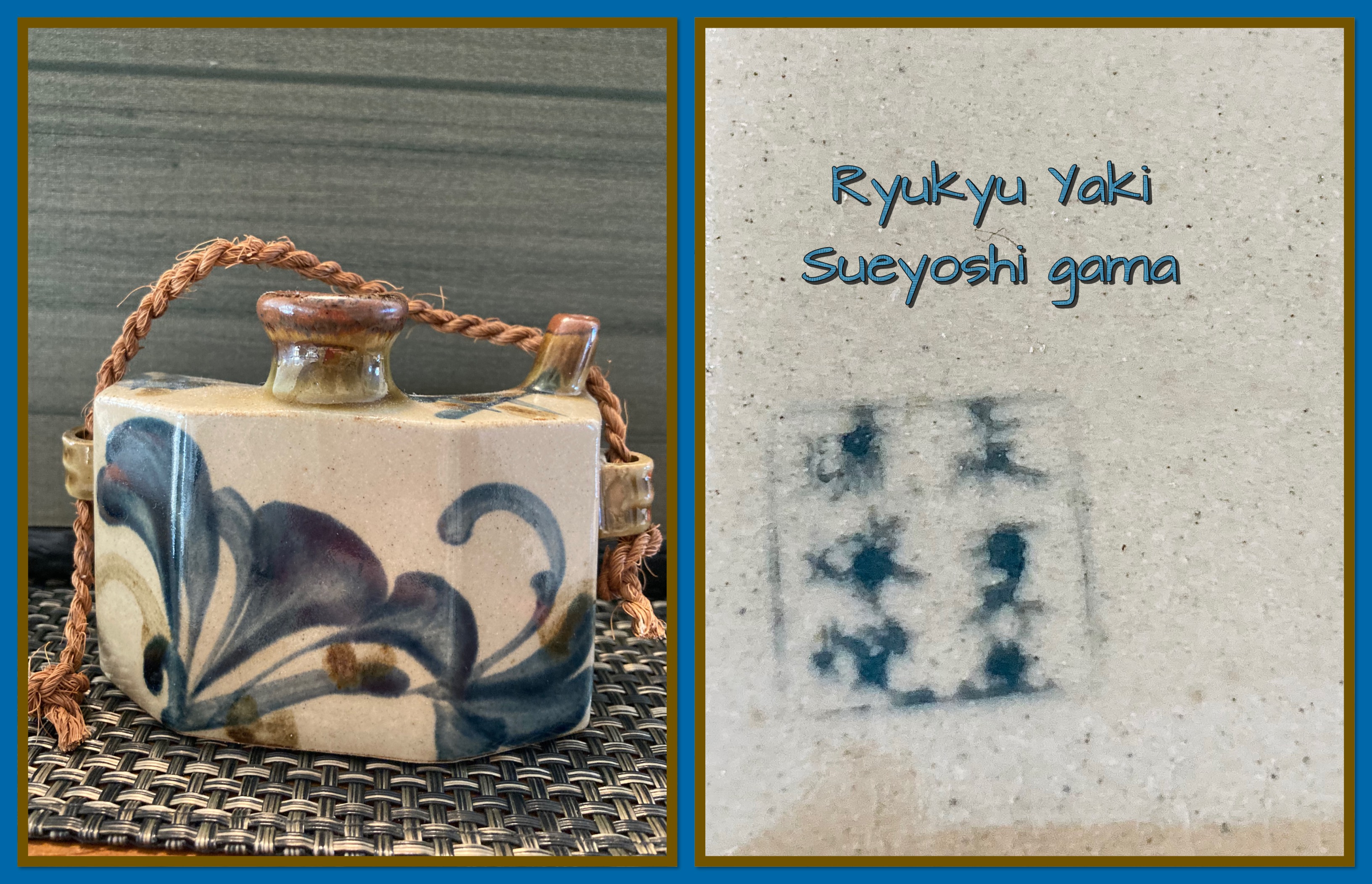
TSUBOYA YAKI (壺屋焼き), KOZA YAKI (胡差 焼), RYUKYU YAKI (琉球焼)-Ceramics of Okinawa Prefecture

Tsuboya-yaki is the traditional pottery of Okinawa. It is also refered to as Yachimun (やちむん). The most common motif is probably the carved fish.  A friend of mine gave me a lovely Dachi-bin with the popular fish design on it. Koza Yaki is made in Okinawa and is very similar. Depending on which town it is made in will determine what label is used.

   Kinjo Toshio 金城敏雄
younger  brother of LNT Kinjo Jiro.


I recently (11/2022) visited Okinawa Yachimun dōri area. I got this wonderful piece by Kobashigawa Hiroshi (小橋川弘).

                                          https://tuboya.com/member/小橋川-弘/


  Here is a piece I bought at Nio Gama 

                                            https://tuboya.com/member/島袋-信子/


                                This shape of bottle is called Tonaki bin in Okinawa dialect

Suiteki-water dropper unsigned 


                                                            Small dachi bin/hip flask


Yunomi tea cup 

Sake cups (unmarked) 

mini pot


Aragaki Eiichi 新垣栄一


Aragaki Eisaburō


Generic Ryūkyū mark 琉球


   Shisa, typical tourist ware from Okinawa


Small sake cup by the son of LNT Kinjo Jiro. His name is 金城敏昭, Kinjo Toshiaki.


                                      Unmarked ewers

                      This is a Koza Yaki (胡差焼) bottle


                           Koza Yaki Yunomi tea cup


Miyagi Sumiko, daughter of LNT Kinjō Jirō


Monday, October 22, 2012

OBORI SOMA YAKI(大堀相馬焼き)-Ceramics of Fukushima Prefecture

I love the Obori Soma-yaki pottery with its typical crackle glaze and horse motif.  Of course there is more to it than that but that is what I think of when hear Soma-yaki.  After the earthquake, tsunami and nuclear accident the soma-yaki potters lost everything.  Some have banded together to try to revive the craft.  As far as I know things are still at a stand still and no pottery is yet being produced.  I hope that this beautiful pottery will be able to be revived in the near future.
Update:
https://www.nippon.com/en/japan-topics/b02343/fukushima’s-suetoku-pottery-moves-beyond-311-toward-the-future.html

Many of the Soma wares are double walled. It is called "Niju-Yaki". The crackles on blue Porcelain are called Ao-hibi. The heart shape cut outs represent plovers (Chidori). Notice the wavy brush pattern below? That represents waves. This combination of plovers and waves is called Nami-Chidori in Japanese, and is a common motif in Japanese arts. (Some people think the cut outs are hearts and I was told they were here hoofs but in the link below the artisan explains the motif. 


Added a sake cup to my collection-no mark


SUE TOKU KILN. 陶徳窯
This is not a piece that I own but was given permission to use these photos for this blog so that it can help others. Mr. Sue lost everything in the Tohoku earthquake and tsunami. He tried to make a come back. He has since passed away. 


KOZAN GAMA (幸山窯)


Hankatsu

https://www.hankatsu.com/

Here are some catalog pages from a 1962-1963 Mail Order Gift Catalog of the Far East Exchange Service. (Thanks to Prudencio Rodriguez for allowing me to post from his collection)


Tuesday, July 10, 2012

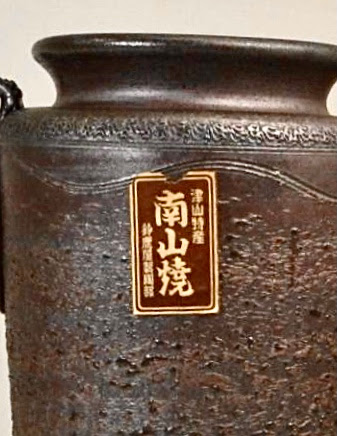
NANZAN YAKI (南山焼き)-Ceramics of Okayama Prefecture


Nanzan yaki. It has taken me years to find the origin of my vase!  Following little breadcrumbs here and there led me to the discovery.


Nanzan Yaki was founded by Koike Torajiro of Tsuyama city, Okayama Prefecture. It is sometimes referred to as Bizen-Tsuyama Yaki or because of its location. Its origins are in Bizen ware. Some references say the kiln was abolished around 1945, others 1949/1950, so this is probably why very little is available on the internet. 


Yanagisen/Ryūsen or Yanagizan Rūzan Zo


The writing inside the pot design reads Nanzan Yaki
Right to left is written Yanagizan or Ryūzan Zo 


Google translation of the history of Nanzan Yaki ( names may be incorrect as Google translate especially has difficulty with Japanese names). 


There are various theories about the opening of the Nanzan-yaki kiln, and it is said to be during the Tenpo era or the 9th year of the Meiji era.  The founder is Mr. Torajiro Koike of Tsuyama.  At first, I called a potter from Kyoto and mainly fired tea pottery.  At that time, it was loved because its firing was elegant.  After that, mass-produced daily miscellaneous goods continued for a long time, but the kiln was abolished around 1945.  The kiln at the time of the abandoned kiln was Mr. Torajiro Koike (grandson of the founder), and the potters were Mr. Yanagisen/ Ryūsen Fukugo and his younger brother Futetsu Fukugo.

Apparently after the kiln closed a disciple of Torajiro, Fukugo Tooru moved and established Sesshu Yaki in Shimane Prefecture! (See post on Sesshu Yaki)

Koike Torajirō


Saturday, May 26, 2012

SATSUMA YAKI (薩摩焼き)-Ceramics of Kagoshima Prefecture

Satsuma of Kagoshima Prefecture is considered Hon-Satsuma or the original Satsuma. In the West Satsuma gets all lumped together in one big lump, but there is usually a great difference between the style and quality of the Satsuma labeled wares. Satsuma style spread to Kyoto (Kyo- Satsuma), Kobe, Yokohama, Ishikawa and other areas. Some makers imitated Satsuma style in porcelain as well. It can be rather confusing to novices. Unfortunately during the export boom of the late 19th century and early 20th century a lot of what Westerners call Satsuma is anything but! There is a lot of enameling and moriage styles that claimed the Satsuma label. In all, there are many levels of quality of Satsuma and Satsuma styled wares.
Within Hon-Satsuma there are different styles. White Satsuma, black Satsuma, Naeshirogawa, Ryūmonji, Jakatsu ( snake skin) among others. 

                   Rice bowl by Chin Jukan 12th generation 


    Tea Bowl 薩摩久晋製


Satsuma Tanoura MARK


Vase box from the Tanoura Kiln 田の浦窯

About Tanoura kiln
http://item.rakuten.co.jp/rai-rai/c/0000000102/
http://www.kurozyokaya.com/product-list/16

Black Satsuma

Generic Satsuma MARK  さつま


Black matte finish began 1930's~ 

Generic Satsuma 


Satsuma Ryuho MARK 龍峰

Satsuma Nagata


Tea cup  made from ash from Sakura 
Jima in Kagoshima

Wednesday, May 16, 2012

SESSHU-YAKI-雪舟焼 Ceramics of Shimane Prefecture

Sesshu-yaki is pottery of Shimane Prefecture, grouped with Iwami-yaki. Sesshu-yaki is a new style of Pottery, the kiln began in 1949 by Fukugou Tooru. His son, Fukugou Tooru II,  took over the kiln in 2001.


Love the "crackle"!!

Featured Post

Helpful Vocabulary When Researching Japanese Ceramics

Vocabulary when searching for Japanese Ceramics *I will be adding to this list Dating   ( 江戸) Edo Period (1603-1868)   (江戸 前期) Ea...