There is a lot of confusion on the various marks used by the Fukagawa Seiji and Koransha companies over the years. When you check out the various auction sites you will find many fairly modern pieces being sold as Antiques. Some Koransha items are seen advertised as Fukagawa and visa versa. One must know their stuff if they decide to purchase items on these sites. Seiji Kaisha was also an off shoot of the original Koransha company.
I am building a collection of marks with their general time periods. It is a work in progress.
I am thankful for the book "Meiji Arita..." for help with additional marks of the Meiji period.
Both Fukagawa Seiji and Koransha were established by the Fukagawa Family (with others) and they have held the leadership in both companies throughout. Seiji Kaisha is interwoven in the mix as well, having been established by Koransha people (which lasted about twenty years).
The Fukagawa family made ceramics for generations but in 1879 they established Koransha. After the death of the father in 1889, the second son began Fukagawa Seiji in 1894. Obviously the companies are intertwined as they are both headed by Fukagawa descendants.
Here are some helpful sites for both Koransha and Fukagawa Seiji (some English, some in Japanese with great pictures):
http://www.koransha.co.jp/koransha/koransha_english.html
http://www.fukagawa-seiji.co.jp/cotp/forenglish.html
http://www.fukagawa-seiji.co.jp/archive/index.php
http://www.ac.cyberhome.ne.jp/~momochi-linden/aaa.html
This one is in Japanese but has some Fukagawa and Koransha marks ranging from late Meiji to early Showa period.
MARKS
I will break the marks down by decade as a general rule, but keep in mind that there will be overlap as Fukagawa/ Koransha did not start and stop marks by decade. Some marks continued for decades.
Circa1860's
Circa 1870's
Circa 1880's
Circa 1890's
Lesser quality ware sold after the close of the company
Seiji Kaisha 1879-1897 ( the Seiji Kaisha mark was used for several years after the close of the company). The lesser quality wares were decorated after the close of the company by former workers and others who used the Seiji a Kaisha mark. Trademark laws were not created at that time. Marked blanks were later decorated and sold by others.
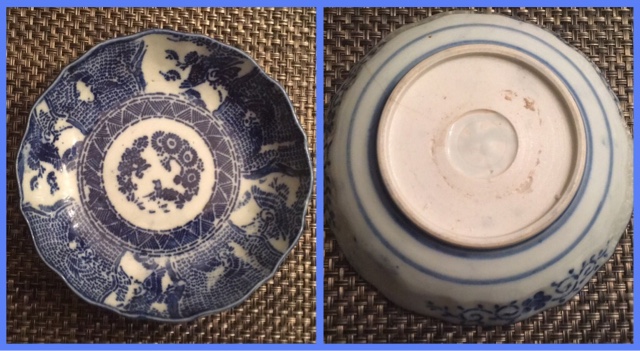
Sharon Meredith provided the pictures of this wonderful Koransha plate. The "Fukagawa Zo" mark was used in the latter Meiji period before Fukagawa Seiji broke off from Koransha. I place it in the 1890's because according to the Koransha website the "Fukagawa Zo" mark was used before the break up in 1894, however it possible that it was made in the mid to late 1880's as there is a somewhat similar plate in red under 1880's in the archives of the Koransha site.
Fukagawa Mark believed used from the mid 1890's through first quarter of the 20th Century
Circa 1900's-1920
This Dai Nippon Arita Fukagawa Sei Mark is listed under Meiji era in the Fukagawa archives.

Circa 1920's
According to the Koransha company website this mark was from the early Showa Period 1926~
Circa 1930's
This Koransha vase is believed to be circa 1930's
Pre war
Pre war
Circa 1940's
1941
During the war years production continued domestically to some extent under government control, but there were no exports.
Circa 1950's/1960's
Used on dinner ware for foreign markets
Koransha (*continues)
Circa 1970's~
Fukagawa, Kanyo Sometsuke. Nancy N. Schiffer's book Imari, Satsuma and Other Japanese Export Ceramics 1997 puts this mark at 1977, design by Iwao Fukagawa.
This is Fukagawa, marked Kanyo sometsuke 官窯染付
KORANSHA
From 1975~
Circa 1980~
Fukagawa
Fukagawa Iroe Saiji Mark from latter part of 20th Century (c.1980's)
Modern Fukagawa mark with red "double happiness" mark on inside lid.
I saw this at an antique shop in Japan. The shopkeeper was quite sure it was old Fukagawa from before the war. I had serious doubts about that even though some of the decoration gave an old style impression. After googling for a while it was quite evident to me that this piece was quite modern, no earlier than the 1980’s and likely later than that. I saw some boxes with barcodes! That would put it near the end of the 20th. It is possible that the old style design was part of a new product line. I saw sake sets, tea sets, wine cups, lidded rice bowls and more with this same motif. I’ll try to check into it more. In any case it is quite a striking piece with the contrast between the orange and the blue /white, finished off with the gold cranes.
.
******************************************
2015 Store Fukuoka Daimaru Display
Also see: http://www.meiji-imari.com/en/meijiimari_en/meijiimari03.html
http://www.fukagawa-seiji.co.jp/archive/index.php
*****************
Current design Koransha set of five dishes
*************
2019 Visit to the Fukagawa Main Store in Arita