Wednesday, March 15, 2017

Tuesday, February 28, 2017

Nippon Tokusei-Japan Special Made


Nippon written right to left indicates pre- WWII 本日. Nippon written left to right indicates post-WWII  日本.

Pre-war


Post war

Pre war

Post war

Pre war


Tuesday, January 17, 2017

AWAJI / MINPEI YAKI (淡路民平焼)

http://www.tklibby.com/Awaji_Pottery.html

http://www.gotheborg.com/marks/awaji.shtml

Otagiri Mercantile Company OMC

The This company was in business from 1954-1994. It was bought out by Enesco in 1994. Registered in NYC and San Francisco. Recognized by its gold diamond shaped sticker  with OMC.

Otagiri imported wares from many Japanese kilns/companies. Most were marked with an OMC sticker. However some were produced especially for Otagiri and have an incised mark or a transfer mark with Otagiri. These appear to have been made around the mid 1970's to mid 1980's. 

Imports from Japanese Kilns/companies include:

Kozangama (Mino)


UPDATE:
SEIZAN GAMA 


***There is uncertainty even among Japanese sites as to the reading. 
From comparison of the bone script characters, I am going with Seizan for this and another similar mark.


*These are similar but not exact. Both appear to be Sei in bone script, although on many Japanese sites the mark on the left uses the Ken reading. 

 Gold Imari (Nagoya)


Meito 明陶


Kutani 九谷


Seihogama 正峰窯


Soma Ware

Tetsusaburo Gama 哲三郎窯 (ARITA)

Touhou


Shibata Toki 柴田陶器 


The Handcrafted Otagiri Original sticker/mark file date Dec 5, 1977~

Incised and transfer marks


Sunday, December 18, 2016

Fakes, Forgeries or Reproductions

Though not as common as in Chinese ceramics, there are fake Imari wares made. Some imitations of great potters have also been made. Most of these would be considered reproductions or wares made in the style of an admired potter,  like Ogata Kenzan, Nonomura Ninsei and others. There are, however, a rising number of forgeries being made of Old Imari porcelains and such. Listed below are some links that help explain how to identify the fakes.


Kutani 
There are many Kutani reproductions made. Some people may try to pass off reproductions as originals.

Kutani still makes ceramics in the old styles like Yoshidaya. It is called "Yoshidaya Fu". This means in the style of Yoshidaya. Marks are also reproduced.
One must look at several factors in determining reproductions, age, etc.

Arita Yaki (Decorated in Macau)


Noritake and Nippon ware imitations

http://www.urban.ne.jp/home/nomnom/JONFCrepro.html

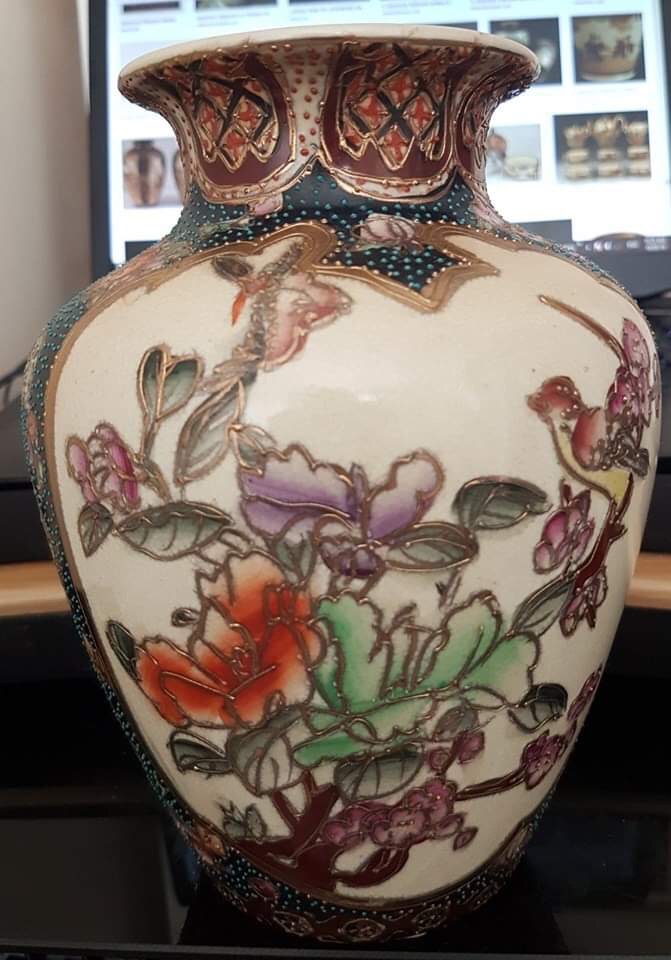
FAKE SATSUMA

Chinese imitations of Satsuma are quite common. Some of the marks are very well done. here are examples of the workmanship and accompanying marks. Thanks to my friend SS for providing the pictures.


Featured Post

Helpful Vocabulary When Researching Japanese Ceramics
Vocabulary when searching for Japanese Ceramics *I will be adding to this list Dating   ( 江戸) Edo Period (1603-1868)   (江戸 前期) Ea...