Friday, August 26, 2016
Bakumatsu Blue
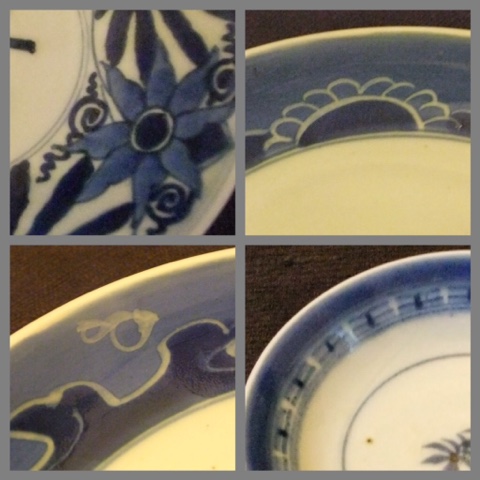
While researching ceramics of the Edo Bakumatsu period (roughly 1853-1867) I noticed a blue color combination (medium gray/blue with a darker, but not cobalt blue, often with (墨弾) Sumihajiki, a resist method used to on ceramics to leave white areas when painted or glazed. I will call this "Bakumatsu Blue". Not all ceramics made during the Bakumatsu period used this blue combo, but it was widespread. Similar combinations were used much earlier in the Edo period with slight variations.
Tuesday, August 23, 2016
Japanese Military and Memorial Sake Cups
This is certainly a work in progress. I will continue to add as I find examples.
SITES FOR RESEARCHING
https://www.militaryantiquesmuseum.com/js388-1930s-japanese-sake-cup.15048.archive.htm
Friday, August 19, 2016
Yamatoku with additional decorator marks
I am researching Yamatoku marked plates that include additional markings. It appears that Yamatoku produced blanks which were then decorated by others. I have found several marked by decorators.
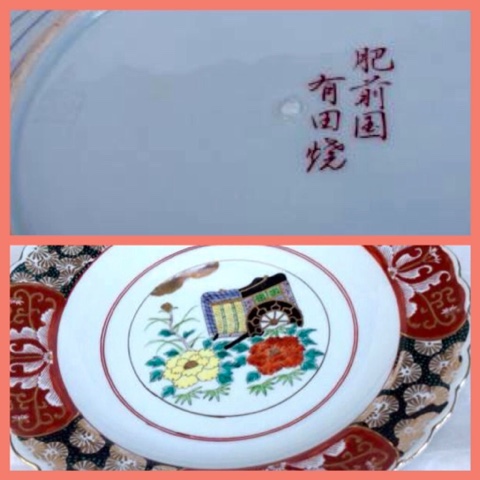
Hizen Arita decorated
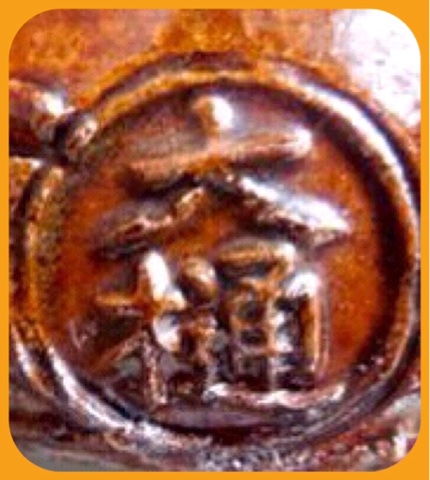
Tetsuka or Tezuka is often found with the Yamatoku impressed mark
This mark is sometimes found on Yamatoku pieces.
![]() |
| Thanks to Maggie Xiao for permission to use her pictures |
Hizen Arita decorated
Tetsuka decorated
The Yamatoku ヤマトク mark is at the top with the red
Tetsuka テツカ mark (up side down) on the bottom.
Here is an example of a Taisho era blue mark with Yamatoku impressed mark
A Matsu mark with a roof meaning house of Matsu. The decorator?
Tuesday, August 9, 2016
Lefton China-imported from Japan
Lefton China was a US importer of Japanese china wares, figurines and novelties. Although the company was founded in 1941, it was after WWII that they imported wares. Some will have "Made in Occupied Japan" but most will just have some variation of Lefton China, Handpainted, Japan. The company was sold in 2000.
Thursday, July 28, 2016
Shimamura Sei (島村製) made by Shimamura
Shimamura decorated porcelain for export in the latter Meiji period and early Taisho period.
http://blog.livedoor.jp/momo2011/archives/2459846.html
Wednesday, July 27, 2016
OHI YAKI-Ceramics of Ishikawa Prefecture
Sunday, July 24, 2016
Taisho Era Ceramics in All Their Variety!
*Under construction. I will continue to add to this over time.
Export Ware 輸出陶器
Much of the Taisho period included Nippon marked wares (1891-1921), which were exported in great numbers to the west. In the latter part of the Taisho period was the start of the "Made in Japan" period beginning Sept 1921. Morimura/ Noritake was producing many lovely western style wares for an ever demanding market. Many other companies popped up with similar designs which causes headaches for collector's today. Many of the records for these companies have been lost or destroyed making it nearly impossible to attribute some marks to particular companies. Some of these companies disappeared after a short time, others were bought by other companies, some continued for many years and some are still in business today.
Transferware small dishes for export with "Japan" marked on it. This was made after September of 1921. They are similar in size to the one made for the domestic market. They must have really been cranking out those plates given the quality shown here.
These were likely made in the early 1920's for export. You can see that the wobbly dish (very uneven) as well as the kiln flaws indicate rapid mass production with little quality control. They are, however, quaint and an example of trying to meet the high demand in the export market.
The saucer size (11cm) is the same as the small mamezara made domestically during the Taisho period.
Domestic Transfer ware 印判
The small plates above are all transferware of the late Meiji to Taisho era. These are very typical of the wares of the period and they are found in abundance in most antiques shops in Japan. Most come in blue and white but green was also popular. The quality varies as you can see. The typical small plate re called "mamezara" (bean plate), were generally 11cm in diameter, where as in the early Meiji era they were about 10.5cm.
This 24cm serving plate uses the old motifs but uses transfer, some hand painting and luster. The colors used were updated to the "times". I would date this between 1921-1930. If not for the luster I would have marked it somewhat earlier.
This transfer ware small dish is a bit nicer (clearer transfer, mounding and glaze) and so probably is later Taisho or perhaps early Showa era.
This is a Kutani lid to a bowl that probably dates to the Taisho period according to similar wares I have seen.
Thursday, July 21, 2016
Sango China
These were obviously found in a thrift shop but have the typical Sango mark. Mid 20th century c. 1960's
Made in Gifu Prefecture 1932~
Monday, July 18, 2016
Helpful Vocabulary When Researching Japanese Ceramics
Vocabulary when searching for Japanese Ceramics
*I will be adding to this list
Dating
(江戸) Edo Period (1603-1868)
(江戸前期) Early Edo period (roughly 1600's)
(江戸中期)Mid Edo period (roughly 1700's)
(元禄時代) Genroku Jidai (1688-1704) "The Golden Age"
(江戸後期)Late Edo period (roughly early to mid 1800's)
(天呆時代) Tenpo Jidai 1830-1844
(江戸幕末)Edo Bakumatsu period (1853-1867)
(明治前期 Early Meiji Period (1868-)
*decline in quality 1872-1881 export production increased 150 fold, world market collapse 1882
(明治後期~大正)Late Meiji ~Taisho period (1898~)
*increased development of mass production
(大正)Taisho period (1912-1926)
(戦前) Pre-war
(昭和戦前) Pre War Showa (1926- WWII)
*during the war only domestic production under government control
(昭和戦後) Post War Showa (1946-)
(昭和) Showa (1926-1989)
(現代) Gen Dai contemporary
Japanese Ceramic Export Eras
Here is a rough guideline for EXPORTS to the USA from Meiji period onwards:
1868-1890 either marked with Japanese characters or unmarked
1891-1921 Nippon, Made in Nippon
1921-1940 Made in Japan or Japan
1941-1945 WW II few, if any exports
1945-1952 Made in Occupied Japan
1953~ Japan, Made in Japan
Dai Nippon (大日本) "Great Japan" on many later Meiji, Taisho and even some Showa era exports.
Type of ceramics
上野焼 Agano Yaki
赤膚焼 Akahada Yaki
天草焼Amakusa Yaki
朝日焼 Asahi Yaki
有田焼 Arita Yaki
備前焼 Bizen Yaki
萩焼 Hagi Yaki
波佐見焼 Hasami Yaki
平戸焼 Hirado Yaki
一ノ瀬焼 Ichinose Yaki
伊賀焼 Iga Yaki
伊万里焼 Imari Yaki
犬山焼 Inuyama Yaki
出石焼 Izushi Yaki
唐津焼 Karatsu Yaki
笠間焼 Kasama Yaki
清水焼 Kiyomizu Yaki
高田焼 Koda Yaki
小石原焼 Koishiwara Yaki
古曽部焼 Kosobe Yaki
九谷焼 Kutani Yaki
京焼 Kyo-Yaki
益子焼 Mashiko Yaki
松代焼 Matsushiro Yaki
美濃焼 Mino Yaki
大堀相馬焼 Obori Soma Yaki
小鹿田焼 Onta Yaki
楽焼 Raku Yaki
薩摩焼 Satsuma Yaki
瀬戸焼 Seto Yaki
渋草焼 Shibakusa Yaki
信楽焼 Shigaraki Yaki
小代焼 Shodai Yaki
高取焼 Takatori Yaki
丹波焼 Tanba Yaki
砥部焼 Tobe Yaki
Chinese Markings on Japanese Ceramics
成化年製 Sei Ka Nen Sei
大明年製 Dai Min Nen Sei
太明年製 Tai Min Nen Sei
太明成化年製 Tai Min Sei Ka Nen Sei
大明萬暦年製 Dai Min Ban Reki Nen Sei
奇玉宝鼎之珍 Ki Gyoku Hou Tei No Chin
冨貴長春 Fu Ki Cho Shun (wealth, nobility, longevity and youth)
竒石寳鼎之珍 Ki Seki Ho Tei No Chin
太明清化年製 Tai Min Seika Nen Sei this may be an early “typo” for 太and 清
Helpful Search Phrases
アンティーク和食器 Antique Japanese dishes
陶器 Pottery
陶磁器 Porcelain
輸出陶器 Export Pottery
明治輸出陶 Meiji Export Pottery
昭和レトロ Showa Retro
染付けSometsuke (blue and white)
金襴手 Kinrante (Kin ran te)
カップ&ソーサー cup and saucer
蓋付き茶碗 Futatsuki Chawan or lidded bowl
窯 Kiln (reading can be kama, gama, yo)
窯印 Kamajirushi-kiln mark
瑠璃釉金彩 Azure blue glaze with gold
(墨弾) Sumihajiki is a resist method used to on ceramics to leave white areas when painted or glazed.
焼き締めYakishime is high-fired unglazed stoneware.
陶芸家Tougeika potter
市松模様 Ichimatsu Moyō/checkerboard motif
Made/produced/manufactured:
作 saku
造 Zo
製 Sei
Pottery Terms
Akae- Red picture or painting
Kohiki-
Tebineri - hand pinched or formed
INUYAMA YAKI- Ceramics of Aichi Prefecture
Inuyama Yaki translates to "Dog Mountain" fired. Inuyama ceramics are made in north western Aichi Prefecture, just north of Nagoya. It has a long tradition for ceramics dating from the early Edo period.
Subscribe to:
Posts (Atom)
Featured Post
Helpful Vocabulary When Researching Japanese Ceramics
Vocabulary when searching for Japanese Ceramics *I will be adding to this list Dating ( 江戸) Edo Period (1603-1868) (江戸 前期) Ea...
-
From 1921-1941, wares from Japan exported to the United States had to be marked "Japan" or "Made in Japan". During Wor...
-
Kutani ware is from Ishikawa Prefecture. The markings are often in red, but can be impressed, in blue, gold and sometimes black with a g...
-
There is a lot of confusion on the various marks used by the Fukagawa Seiji and Koransha companies over the years. When you check out the va...