
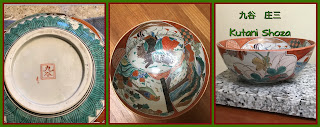
Kutani ware is from Ishikawa Prefecture. The markings are often in red, but can be impressed, in blue, gold and sometimes black with a green background. For more information on Kutani try: http://www.kutani.co.jp/english/kutani350/about_kutani.php

KUTANI FUKU MARKS 福

🌸🌸🌸🌸🌸
GENERIC KUTANI MARKS
Generic generally means it was produced by a kiln, rather than by a single potter/decorator. However, with sets for example, one piece can have the potter/decorator and the rest of the pieces in the set could have a generic mark. A teapot could have the full name while the cups may have the generic.
As far as "squiggle in a square" Kutani marks, I have seen them pre war and post war through about the 1960's.


Other generic Kutani marks are handpainted and will vary greatly in size and writing style. Some may have a red, maroon or black backdrop with Kutani in gold. Some may be incised.


Decorative mallet and small sake cup


Bottom small dish with peacock motif, 九谷

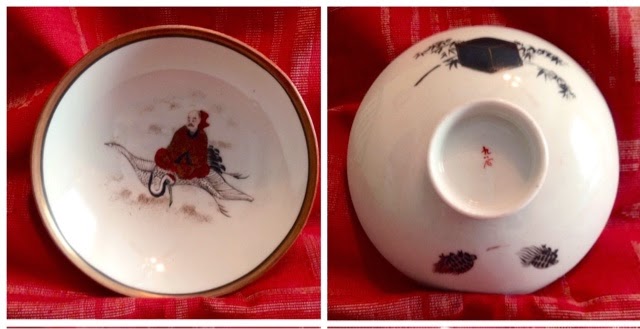
This is a lid to a covered bowl, Meiji Era.

Old "Hanazume" style cup

Vintage, Generic Kutani, nut cups


Koma Inu, also known as Shi Shi, Shisa, and foo dog. Generic Incised mark.


Mid century Kaku Kutani mark


I love this little Foo dog! The details on this sake cup are lovely!


Generic Kutani with crimson background mid 20th century
GENERIC KUTANI MARKS WITH SEI (製) OR ZO (造)


Small bajohai style sake cup with kirante deco on the base with saiji writing inside.
Kutani Sei (produced by Kutani) Meiji Era
GENERIC KUTANI (specialty)


🪷🪷🪷🪷🪷🪷🪷🪷

KUTANI KYOKUZAN (旭山)

TOKUDA YASOKICHI III (代三徳田八吉)

KUTANI TOKUDA YASOKICHI II (代二九谷徳田八十吉)

KUTANI BIZAN (九谷美山)

🌿🌿🌿🌿🌿
KUTANI CHOZAN (九谷長山 )

Vase in Toyama style (mountain range)
|
🌼🌼🌼🌼🌼
KUTANI EIRAKU

In the traditional red and Gold
Top-Meoto or Husband/wife cups/Bottom-sake cup


🌳🌳🌳🌳🌳
KUTANI EIZAN


🌿🌿🌿🌿🌿
KUTANI GAKUYOU (九谷岳陽)


🌾🌾🌾🌾🌾
HANA KUTANI (花九谷)


💐💐💐💐💐
KUTANI YAKI SENZAN ( 3rd generation Suekawa Senzan 1929-2011)

🐇🐖🐈🐓🐅🐉🐑🐲🐀
KUTANI KAKUZAN or KAKUZO (九谷鶴三)

🌾🌾🌾🌾🌾
KUTANI KABURAGI (九谷鏑木)
The Kutani Kaburagi kiln originated in 1822 and continues to the present day. It is one of the great Kutani kilns and has produced wonderful pieces throughout its history.

This sake cup is decorated with the famous old couple "Jou and Uba" from the Noh play called Takasago. It is beautifully done.
🌼🌼🌼🌼🌼
KUTANI KASEN (九谷華仙)


🌼🌼🌼🌼🌼
KUTANI KOSEN (九谷光仙)

The Kosen kiln produces many pieces in the Yoshidaya style

🌿🌿🌿🌿🌿
KUTANI NANSHUN (南春)

🌿🌿🌿🌿🌿
KUTANI NIPPON TOUGEI 九谷日本陶芸

This tea cup is from a set of five, the traditional number used for sets.
🌺🌺🌺🌺🌺
KUTANI RYUZAN (九谷隆山)


🌸🌸🌸🌸🌸
Kutani Shoei 九谷彰栄

KUTANI SHOZA


KUTANI SHOKAKU (九谷松鶴)

KUTANI SHUZAN 九谷秀山

KUTANI SOSHU (九谷宗秀) Known for his "Ginsai", silver leaf style

20 cm tall Blue/silver vase

Pink/Silver sake cup
Here are some links to similar items of the same kiln:
http://www.artisticnippon.com/product/kutani/ginsai_pair_yunomi.html, http://www.trocadero.com/kodoarts/items/509311/
🌾🌾🌾🌾🌾
KUTANI TAIZAN

KUTANI TOUMEI

Tea cup (Yunomi) with camillia motif


Small 7 piece Kutani tea set with Saiji writing,
Tousen signature on the box

Sake cup
KUTANI SHOGETSU (九谷松月)

Kutani meoto (husband-wife) cups with Camillia flowers
|
🌿🌿🌿🌿🌿
KUTANI SHOZA and MOKUBEI (Reproductions or made in the style of)

🌿🌿🌿🌿🌿
KUTANI KINZAN (九谷金山) *best guess on the reading
 Lidded husband/wife tea cups with miniature writing (saiji) and blue dot (ao chibu) technique. 🌿🌿🌿🌿🌿 |
 |
| 3 tiered Obento Takahashi Mark-filed under Kutani on a few sites I have researched HOWEVER, the mark reads Dai Ichi Toki 第弌陶器 which is a different company. |
 |
| Takahashi three tier bento |
 |
| Kutani sake set 🌺🌺🌺🌺🌺 |
KUTANI RYUSEN (九谷龍仙)
 |
| Kutani Ryusen |
 |
| For celebration at Ohara Hachiman Jinja (1981) Kutani Ryusen MARK |
KUTANI MARUYAMA


🌺🌺🌺🌺🌺
KUTANI KAKUZAN

A sake set with two tokkuri and five cups
 |
🌿🌿🌿🌿🌿
KAGA KUTANI


🌺🌺🌺🌺🌺🌺🌺🌺🌺🌺🌺🌺🌺🌺🌺🌺🌺🌺🌺🌺🌺
KUTANI ODAKE (九谷雄岳) * one possible reading for this kanji.
aka Higashi Tadao 1931-2013

KUTANU YOUHO (九谷勇峰)

🌼🌼🌼🌼🌼
KUTANU YOUHO (九谷勇峰)

Large vase
🍁🍁🍁🍁🍁

http://www.ho-shi.co.jp/jiten/Houshi_E/kyu.htm
🌿🌿🌿🌿🌿
MOE GAMA (萠窯)
The kiln established 1997 by Takeuchi (竹内 靖), a Kutani trained potter.

link:
http://www.pref.ishikawa.jp/kutanike/ob/moegama.html
🌺🌺🌺🌺🌺
KUTANI CHINZAN 九谷枕山

🌺🌺🌺🌺🌺
KUTANI IWAHANA DO 九谷岩花堂 (needs verification on reading)

KUTANI CATS

Although there is no Kutani mark, this style is attributed to Kutani. It has the red MIJ mark.


Tanioka Taizan sei

Late nineteenth century Kutani bowl
Kutani Gyokusen


*Aotsubu/aochibu, meaning blue green dots, was used from the Taisho period on.
****************************** Kutani Seikou Kiln


**********************


Yamazaki Kutani MIJ (Mark used before and after WWII)

Yamazaki Kutani MIJ (mark used before and after WWII)


Yamazaki


********
Kutani Tōshun


KUTANI KINEN
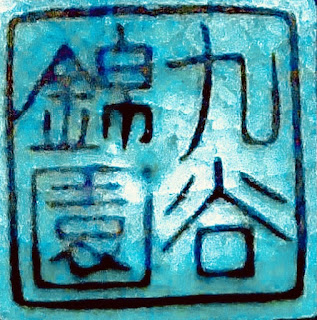

Google translation:
Artist's Profile
Born in Komatsu City, Ishikawa Prefecture in 1955, studied under Isokichi Asakura, the second generation, a potter of the Order of Culture (10 years later became independent). In 55, he was selected for the first time in "Nitten" (17 times since then, a friend of the Nitten Kai). 59 years, Ishikawa Prefectural Kutani Ware Technical Training Center, Practitioner ース卒業 62 First solo exhibition at Matsuya Ginza store Heisei 2004 Urasenke Professor studied under Mr. Sojun Ise 05 years Hosho school Noh actor Toshihiko Yabu started 14 years Ishikawa Prefectural Assembly Building Entrance Hall Ceramic production 22 years Selected for the first time at the "Japan Traditional Crafts Exhibition" 23 years became a member of the Kawabata Yasunari Society 24 years Jury member of the Nomi City Art Exhibition 25 years participated in the establishment of "Junseisha" presided over by Mr. Jun Takekoshi, and in the catalog of Yasunari Kawabata and Kaii Higashiyama Collection Exhibition, who became a doujin, " Writing "Avant-garde and Pottery" "Junseisha Exhibition" JR Osaka Mitsukoshi Isetan 26th Year Year Hokuriku Shinkansen Opening Commemoration Ceramic Plate Production Nomi City Art Exhibition Jury Member "Junseisha Exhibition" recommended as a full member of the "Japan Crafts Association" Daimaru Kyoto Shop "Junseisha Three People Exhibition" JR Osaka Mitsukoshi Isetan 27th Anniversary of the Kawabata Yasunari Literature Museum 30th Anniversary "The World of The Tale of Genji in Kyoto attracted by Yasunari Kawabata" (Mashito Tanishiki Pottery Exhibition) held at the Kawasaki City Yasunari Literature Museum "Junseisha Exhibition" Tenmaya Fukuyama Store "Junseisha Exhibition" Fukuya Hatchobori Main Store 29 Years Solo Exhibition Keikyu Department Store Solo Exhibition Isetan Shinjuku Store 30 Years Kutanigamie Cooperative Chairman "Junseisha Exhibition" Ginza Wako Hall 2020 Received the Chairman's Award of the Preservation Society of the Traditional Kutani Pottery Art Exhibition
Kutani China from a 1962-63 Mail Order Catalog (from the Prudencio Rodriguez collection)


