Thursday, February 13, 2014

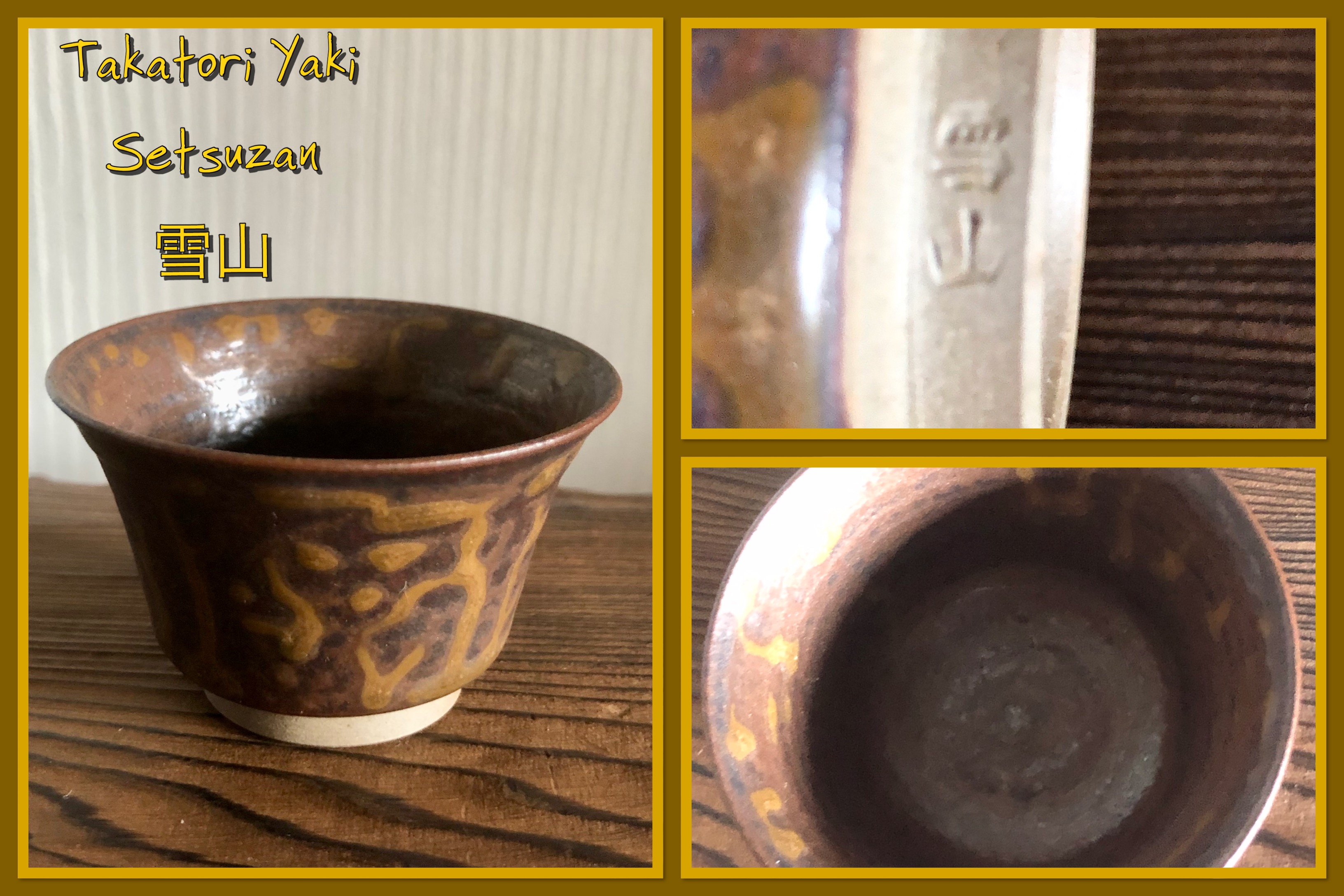
TAKATORI YAKI (高取焼き) Pottery of Fukuoka Prefecture


TAKATORI HASSEN 12th 十ニ代高取八仙


13th Takatori Hachizan 十三高取八山


LINK:  www.takatoriyakisouke.com

Also from the same kiln......a guinomi by Takatori Nanae


              Nanae MARK
  
************************************

KAMEI MIRAKU 


     Takatori yaki tea bowl by KAMEI MIRAKU 14 Kiln


                                                                  Kamei  Masahisa (Miraku 15)


Examples of very old Takatori Yaki from the Kamei Miraku museum

Made by Kamei Miraku's son Hisaaki


                                               Made by Master potter Kamei Miraku 14

*************************


****************************************************
Takatori Seizan kiln 


***************************************************************

高取焼永満寺窯たかとりやきえいまんじがま 

Takatori Eimanji gama

〒822-0005 福岡県直方市永満寺2045-1 (located in Nogata)


Shimizu Chikuzan


*********************************************

Below appears to be a generic Takatori MARK


       Takatori yaki sake cup 


                                                 Soba Tokkuri with generic Takatori mark


Guinomi with generic Takatori mark


Thursday, January 23, 2014

OBSCURE KILNS

There are many kilns throughout Japan that are unknown to many in and outside Japan. This is a working list of many lesser known kilns by prefecture, beginning in the north and working south and west. The kiln names have been gathered from many sources. For additional information on older kilns see "The World of Japanese Ceramics" by Herbert H. Sanders, "The Art of Japanese Ceramics" by Tsugio Mikami and "The Japanese Pottery Handbook" by Penny Simpson. Included in this list are old kilns that may no longer exist, local kilns that have long histories and newer kilns that have risen up in the last century. 

AOMORI
Hirosaki
Akudo

IWATE
Kokuji
Kuji 

AKITA
Naraoka

YAMAGATA
Shinjo
Hirashimizu

MIYAGI
Kirikobe
Tsutsumi


FUKUSHIMA
Tatenoshita
Aizu

NIIGATA
Aikawa
Sado/Mumyoi


TOCHIGI
Maganoshima
MIKAMO

TOKYO
Edo Banko
Kenzan Iriya
Korakuen
Sumidagawa
Edo Kikko
Toyama

SHIZUOKA
Shidoro

TOYAMA
Etchu Seto
Kosugi

ISHIKAWA
Ohi
Kasugayama


FUKUI
Hisaka
Oda


AICHI


GIFU

MIE
Akogi (Banko ware beginnings) 


KYOTO
Asahi 
Tango

 
SHIGA
Koshu
Rakurakuen
Shimoda
Takahara
Zeze

OSAKA
Kosobe
Takahara
Nanba
Kikko

NARA
Akahada

WAKAYAMA
Kairakuen
Otokoyama


HYOGO
Higashiyama
Mita
Sanda

TOTTORI
Kazuwa
Ushinoto

OKAYAMA
Mushiake
Shizutani

SHIMANE
Banshozan 
Daito
Fujina
Gotsu
Oda or Ota
Sesshu

HIROSHIMA
Himedani

YAMAGUCHI
Horikoshi

KAGAWA
Kankake 
Tomita

KOCHI
Nosayama
Odo


FUKUOKA
Asakura
Hikosan
Ichinose
Kangetsu
Noma
Sasada
Sue
Takaba


SAGA
Kuromuta
Shiinomine
Shiriaishi
Utsutsugawa


NAGASAKI

OITA
Onta
Tenryo 
Yabakei

MIYAZAKI


KUMAMOTO
Amakusa
Futagawa
Hirayama
Isshochi
Koda
Shodai
Uchisarayama
Yatsushiro

KAGOSHIMA
Chosa
Hirasa
Kushikino
Naeshirogawa
Tateno


Saturday, January 11, 2014

KOI-not ceramic but very fun!

This is not Japanese ceramic, it is made of cast iron, but it blends so well with my Japanese ceramic collection.  It is a lantern. I think it has a lot of character!

Thursday, December 26, 2013

NIPPON PORCELAIN 1891-1921

After the passage of the McKinley Tariff Act of 1890 countries were required to mark the name of the country of origin written in English on products imported to the United States. "Nippon" was how the Japanese referred to their country, so this was printed on their goods. In 1921 The United States required "Japan" to be used for marking imports. This helps somewhat in dating pieces, although keep in mind that "Japan" and "Made in Japan" were used again after World War II. 

There are generally two categories of Nippon wares, early Nippon and late Nippon. Early Nippon was generally made by groups or families. Gradually manufacturing changed to mass production. Early Nippon wares are more individual in nature, whereas the later wares are more uniform. 

This type of Japanese ceramics was definitely made for export. The Japanese much prefer pottery and simple designed porcelain over the ornate. I must say that I agree! There is a warmth in pottery and a cool sophistication to simple designs.  Since there still seems to be a market for Nippon, I include it here. That being said now and again I find a piece that I like.

HAND PAINTED NIPPON-RISING SUN MARK

                         
                                                        Antique Nippon Hair Receiver

 To be honest I did not know what a hair receiver was initially. With the help of Wikipedia I learned that women had them at their dressing tables to keep the hair removed from their brushes after brushing. The fallen hair was used to stuff pin cushions, small pillows and to make "rats" for adding volume in Victorian hair styles. How resourceful. 

      Celery dish. Hand Painted Rising Sun mark


                                              *********************************************


            This is the Nippon crown/star mark.

                           
            Toothpick holder. This is the Nippon Morimura (Noritake) wreath Mark pre-1918.


       Nippon RC, meaning Royal Crockery


IMPERIAL NIPPON HAND PAINTED


Jonroth Studios NIPPON

Founded 1909


                  *This is one I really like


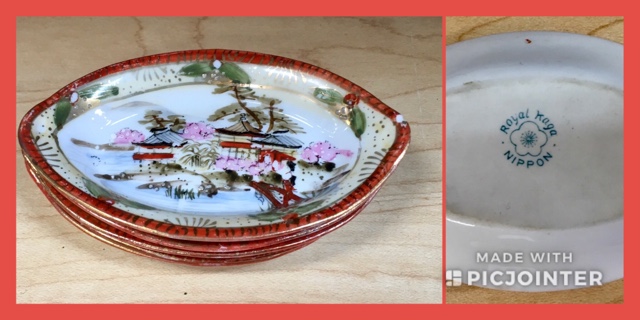
Royal Kaga Nippon

Kaga refers to an area in Japan which is where Kutani wares are made. This patters is often referred to as "Geisha Girl Porcelain". In reality the figures have nothing to do with geisha. 


Thursday, December 12, 2013

Going Gaga Over Guinomi

Many people find that one way to enjoy various styles, types and ages of Japanese pottery is to collect guinomi or sake cups. They display well and they are usually reasonably priced, unless made by a famous artist or a "National Treasure". They don't take up a lot of room in a suitcase or as a display.


LINKS:
http://www.guinomiya.com
http://www.orange-ti.com/guinomitophp.htm


 Top left Takatori-yaki, top right Koda-yaki, low left Shigaraki-yaki, low right Shigaraki-yaki

top left Kutani-yaki, top right Kutani-yaki, low left Tenryo-gama, low right military cups


          Asian Zodiak a cup for each year (8 shown here)      


Soma Yaki


Koransha 


KUTANI KYOKUZAN stemmed cup, bajohai


Whistling sake flasks and cups, mid to late 20th century 

Dragon ware sake cup with lithophane of woman


Sunday, November 24, 2013

For the Love of Mingei


Mingei or folk pottery is sprinkled throughout the country side all over Japan. Mashiko, made famous by the likes of Yanagi Soetsu, Hamada Shoji and Kawai Kanjiro, is probably the most well known outside of Japan. There are so many other beautiful folk potteries that can be appreciated by daily use. The heart of Mingei lies in simple, everyday pottery, made by local craftsmen. There may not be a mark on the pottery because, at least in the past, in "Mingei" it was felt that the work should be enough to identify the craftsman. Using the generic mark is also used to show solidarity as a group of folk artists of a particular style. The storage boxes should have the name and mark if not on the individual piece. Check out my book review page. I list several good books on Mingei or the Folk Pottery Movement.

1931 Soetsu Yanagi quote, catalog of Hamada exhibition:
" .... beauty can never be attained by sophistications of technique, for beauty is a thing of soundness and truth."


Tatsuzo Shimaoka-Mashiko Yaki


Onta Yaki


Koishiwara Yaki, Fukuoka Prefecture


Mashiko Yaki Tea bowl by Hasegawa


Tsuboya Yaki
      Sake flask from Okinawa 


    Shodai yaki of Kumamoto Prefecture by Inoue Taishu


Tenryo Gama of Oita Prefecture. Known for its reddish and purple glazes.


Koda Pottery, the lesser known of the Kumamoto kilns. This kind of pottery was really my introduction to Japanese pottery so it remains one of my fondest. 

Monday, November 11, 2013

FUKUMITSU YAKI (福光焼き)-Ceramics of Toyama Prefecture


 Fukumitsu pottery is made in the Fukumitsu district of Nanto City. It is a hand moulded pottery. I only know of one kiln, Fukumitsu Toen. Though Toyama is not known for its pottery keep in mind that this area is not too far from Ishikawa Prefecture, home of Kutani and Ohi ceramics.
The master potter is Matsumura Eikichi 松村栄吉. 
Information about this pottery was almost impossible to find as it is not a major pottery style. I saw a set of this kind of sake cups on ebay mislabeled by a Japanese seller as Fukuko, same mark but incorrect reading. It wasn't until I searched and searched on a map of Toyama that I came across the mistake. The kanji 光 can be read as Hikari, Ko and Mitsu, among others.  Once I found the correct reading and location I finally found the kiln. Now I finally know where these cute little cups come from!

***Do not confuse with Fukumitsu Yaki of Tottori Prefecture. 

Sunday, November 10, 2013

DAI NIPPON (大日本)- Great Japan


KITAGAWA-ZO, made by Kitagawa (北川造)


From what I can get from both Japanese and English sites there was a famous Kitagawa who made and/or painted export wares that went out of Yokohama during the Meiji Era. Some are marked Dai Nippon (大日本) Kitagawa-zo (北川造) like the mark above (probably from the 1890's through the early 1900's). There are also other Kitagawa marks such as Kitagawa-Sei and  Kitagawa Kisaku-Sei. Worthpoint attributes Kitagawa zo markings to Kitagawa Kisaku. The gbouvier Kutani site has Kitagawa under Kutani. From what I have read of the history of this time, potters and painters from Kutani were sent to the Yokohama factories to crank out wares for export so the Kutani Kitagawa may very well be the Yokohama Kitagawa. There are some examples of Kitagawa works with Kobe written. Is it possible that Kitagawa goods were also made to be exported out of Kobe as well?  The workmanship of all the Kitagawa marks and painting style look very similar. At any rate, Kitagawa made pottery seems to have been made from the 1890's through at least the early 1900's.

                                    Dai Nippon Houzan Sei 

Unknown maker

Saturday, November 9, 2013

MILITARY SAKE CUPS


These two sake cups are unusual. The cup on the left has three Japanese traditional symbols that represent "long life", crane, turtle and pine (or evergreen).  
The one on the right has crossed Japanese flags. Most cups from this era that I have seen have one Hinomaru and the other is the flag the Japanese army and navy used in WWII with the red sun in the middle with red rays.  This one has both Hinomaru flags. 


I just found this one at a shop in McLean that is going out of business.
The couple who runs the shop are retiring after over 20 years. 
No mark.

Featured Post

Helpful Vocabulary When Researching Japanese Ceramics

Vocabulary when searching for Japanese Ceramics *I will be adding to this list Dating   ( 江戸) Edo Period (1603-1868)   (江戸 前期) Ea...