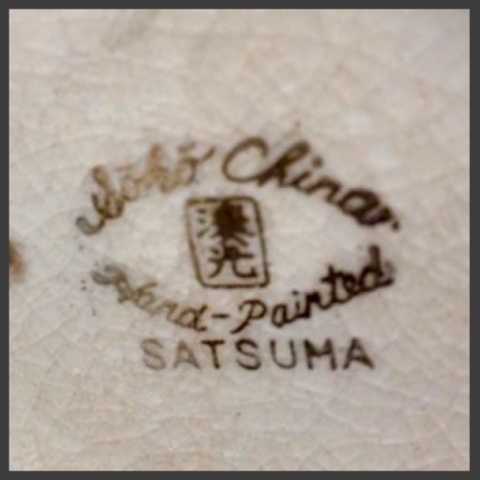
Sōkō China, also known as Kobe Satsuma.
Friday, June 16, 2017
Thursday, June 15, 2017
Tuesday, June 13, 2017
Friday, May 26, 2017
Mark Links
https://saga-museum.jp/ceramic/e2b3e72582c0973d627f8f7415c2235a.pdf
https://www.gotheborg.com
http://www.e-yakimono.net
https://japanese-ceramics.com/marks-of-japanese-pottery-and-porcelain/
Wednesday, May 10, 2017
Gold Imari
The original kiln, Yazaemon of Arita began in 1804. The kiln was run by the Matsumoto family. The fifth generation began exporting to North America and Europe.
Gold Imari was produced by Arita Bussan from 1951, registered in Nagoya. (1959-1984)
NO 8,3-CHROME
IIDA-MACHI, HIGASHI-KU
NAGOYA, JAPAN
https://trademarks.justia.com/owners/arita-bussan-co-ltd-285723/
Older mark ?
Monday, May 8, 2017
Friday, April 28, 2017
Books about Japanese Ceramics (in Japanese)
If anyone has a chance to visit Japan take time to check out the used bookstores for books on Japanese ceramics. There are some chain stores like "Book Off" and "Tsutaya" that sell used books. There is a great old book shop area in Umeda, Osaka that has used books, rare books, prints and such. There is also some little bookstores in Osaka, near the American Consulate. In Tokyo there in an area where they have many old bookstores, but the name escapes me right now. Regular bookstores usually have a section on ceramics with new books published within the last few years.
Many exhibitions and museum shops carry very nice catalogs and books on Japanese ceramics.
Travel Series
Friday, April 21, 2017
Soeda Washin 添田和信
Fukuoka potter Soeda Washin, at his show at Mitsukoshi Department store in Fukuoka. He specializes in Hakeme,brush work.
Tuesday, April 18, 2017
ZEZE YAKI 膳所焼
Zeze Yaki is from Otsu, in Shiga Prefecture. It was one of the seven preferred kilns of Tea Master Kobori Enshu.
http://www.jtco.or.jp/en/kougeihinkan/?act=detail&id=246&p=25&c=31
Friday, April 14, 2017
Subscribe to:
Posts (Atom)
Featured Post
Helpful Vocabulary When Researching Japanese Ceramics
Vocabulary when searching for Japanese Ceramics *I will be adding to this list Dating ( 江戸) Edo Period (1603-1868) (江戸 前期) Ea...
-
From 1921-1941, wares from Japan exported to the United States had to be marked "Japan" or "Made in Japan". During Wor...
-
Kutani ware is from Ishikawa Prefecture. The markings are often in red, but can be impressed, in blue, gold and sometimes black with a g...
-
There is a lot of confusion on the various marks used by the Fukagawa Seiji and Koransha companies over the years. When you check out the va...