Sunday, October 25, 2020

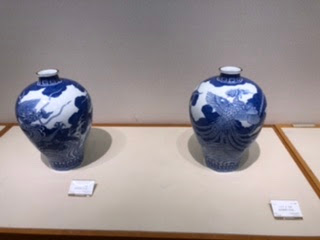
RAKUZAN YAKI-Ceramics of Ehime Prefecture

 Rakuzan Yaki is a fun kind of ceramics. Actually raku means fun...and this certainly is. It is probably most famous for the crabs that look like they are crawling out of the sand in many of the ceramics. The common 3D shrine ware is often confused with Banko ware. So not to be confused, there is also another Rakuzan ware made in Izumo which is associated with Fujina ware.


Sunday, August 30, 2020

Tsuji Seijisha 辻精磁社


These are the works of Tsuji Hitachi, 15th generation 


 With over 300 years serving the Royal family, being the first to be purveyors to the Imperial Household, the Tsuji family has an amazing tradition of excellence in producing exceptional porcelain.


            This older piece from my collection was probably made by either Tsuji 12th or 13th generation.

Here is some of the history of the Tsuji Family. 


Thursday, November 7, 2019

Incense Containers-Kogo 香合


Incense containers, called kogo 香合, are generally used for the traditional tea ceremony to store a few bits of incense. They come in all kinds of shapes. one will see many in the shape of animals, from the Asian zodiac. Other shapes such as fans, fruits, other auspicious animals, etc. are also plentiful. Most styles of Japanese ceramics have versions of kogo. They make wonderful collectables as they are small and come in such huge variety.
One of my favorite books is the Exhibition of Kogo from the George Clememceau Collection.


Hagi by Watanabe Eisen (monkey)

Hagi by Watanabe Eisen (dog and ball)

Mashiko


Thursday, October 24, 2019

IZUMO RAKUZAN YAKI-Ceramics Of Izumo, Shimane Prefecture

I had the pleasure of meeting Mr. Nagaoka at his exhibition in Fukuoka. He took time to sit and talk with me about his work and to answer my questions. I thoroughly enjoyed the visit. He specializes in tea ware. His style ranges from simple hakeme decorated forms to more elaborate detailed designs.


Rakuzan Gama
https://www.nagaoka-kukyo.com/
Nagaoka Kukyo 長岡空郷 (Thank you to my friend Alice Gordenker for providing the
information and photos)


Thursday, July 18, 2019

Ryumonji Yaki-Ceramics of Kagoshima Prefecture


Ryumonji Yaki is sometimes referred to as Black Satsuma, but that is not entirely true. Certainly much of Ryumonji is black, usually with a splash of color glaze somewhere, but there is much more to it than that. Other styles include "sansai" or three-colored, sharkskin, white shark skin, as well as brown, blue and ochre glazed ware.
see:
http://ryumonjiyaki.jp/gallery/index.htm


Here is an example of black Satsuma with a blue/green flow glaze


Saturday, June 22, 2019

ONODA SUE YAKI- Pottery of Yamaguchi Prefecture


These jars are made for umeboshi and are sold as a delicacy of Kokura. I love the umeboshi but always wondered who made the jars! 
I thought they might have been made in Agano or Koishiwara but no. While visiting Kokura yesterday my daughter wanted to buy the umeboshi that come packed in the ceramic jars. We asked one of the sales ladies who made the jars. She hurried away to go find the answer for us. She returned quickly with the information that I had been wanting for years. They are made in Yamaguchi Prefecture, town of Onoda, Sue Yaki (su-e). Onoda clay is high in iron which is perfect for making acid resistant vessels. They mostly make the jars for the umeboshi paste and for strong alcohol. There used to be many kilns but now only Matsui pottery 松井製陶所 remains. 


Wednesday, May 29, 2019

Arita China

Pages from a mail order catalog dated 1962-63 ( from the collection of P. Rodriguez)

Arita China


The Mark


Yamato China


Yamato China from a mail order catalog dated 1962-63 (from the collection of P. Rodriguez)


Wednesday, April 3, 2019

Tokanabe

                Tokanabe Wall Pocket. These were made for export in the 1920’s and 1930’s

Friday, March 15, 2019

KINKOZAN-錦光山


There is much written on Kinkozan which is available on line. I will not give the history of the Kinkozan factory here. I will only say that although Westerners refer to this work as Satsuma, it is not the original Satsuma from the Kagoshima area. Satsuma was produced, mostly for export, in Kyoto and other areas near ports. The quality can vary from excellent to poor, even from the Kinkozan factory. Satsuma wares made for the domestic market are usually more simple, and subdued. Much of the Satsuma for the export market, in my opinion, was rather gaudy and oft times crude, although there are many exceptions to that rule. Kinkozan did produce many exceptional wares. Keep in mind there was another maker that used Kinkozan but the kanji characters were different.


Helpful resources:

http://www.artnet.com/artists/kinkozan/
Treasury of Satsuma by Sandra Andacht
www.kinkozan.com 


Tentative dating- 1920's 

Featured Post

Helpful Vocabulary When Researching Japanese Ceramics

Vocabulary when searching for Japanese Ceramics *I will be adding to this list Dating   ( 江戸) Edo Period (1603-1868)   (江戸 前期) Ea...